
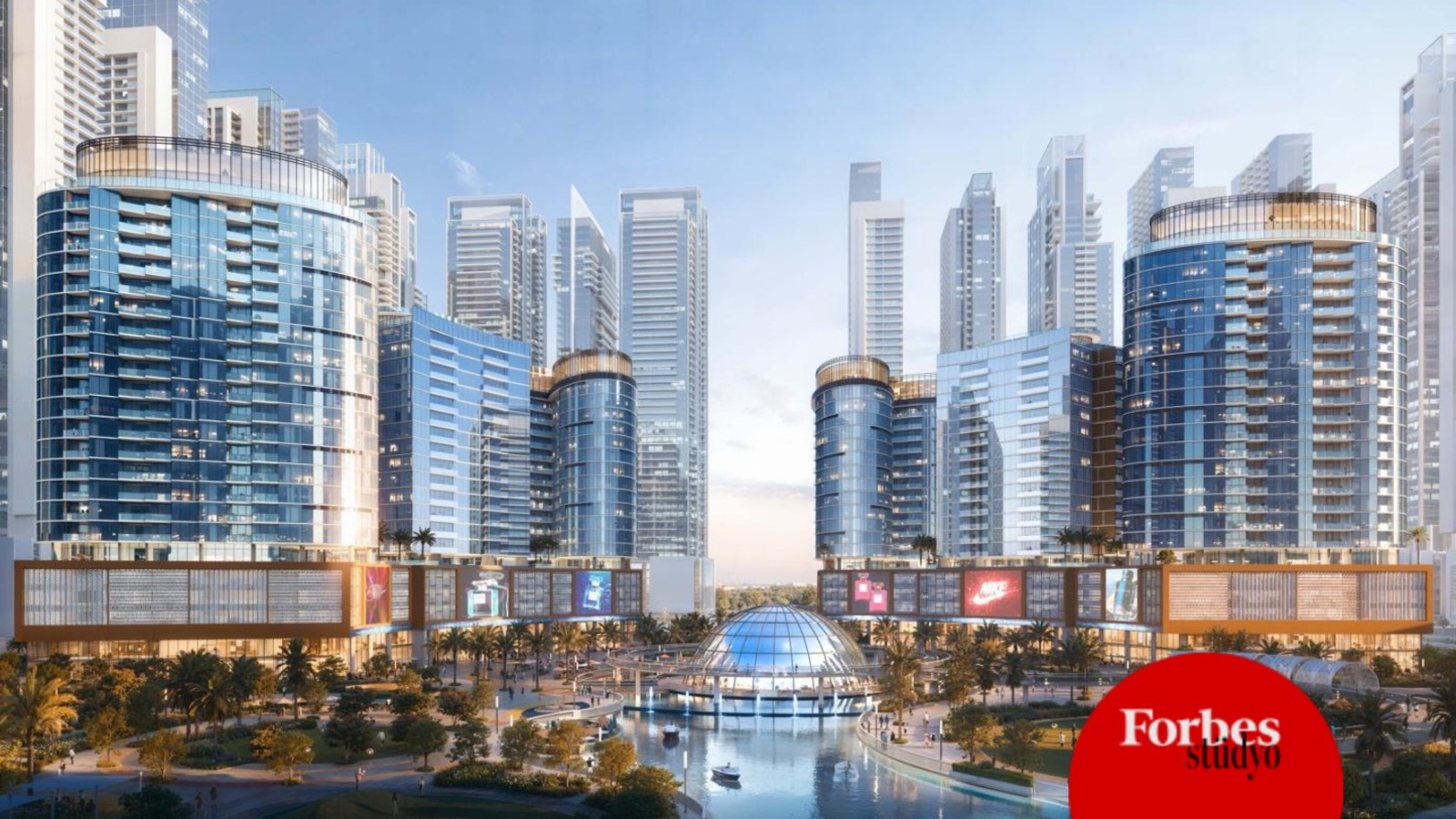
With Tiger Downtown Ajman, Tiger Properties is bringing a similar way of thinking to the northern Emirates, but wrapped around a lagoon. The plan is simple to describe and ambitious to deliver: a city-scale community where most of what you need on a daily basis can be reached in a few minutes on foot, with a private lagoon at its heart.
A lagoon city planned for short walks, not long drives
Tiger Downtown Ajman is one of the largest new masterplans in the emirate. According to project information, it is structured around:
- 76 buildings in total
- 20 lagoon-front buildings and 56 perimeter buildings
- A central lagoon of about 13,795 square meters with a 375-meter water edge
- A total built-up area of 5 million square meters, of which roughly 3.38 million is residential
- Around 77,088 square meters of retail and about 41,000 square meters of commercial space
The masterplan is explicitly described as “pedestrian-first,” with walkable promenades, landscaped corridors, external and internal jogging tracks, and elevated walkways connecting buildings, parks, and social hubs.
In other words, the lagoon is the visual anchor, but the real story is the network of paths and public spaces that let residents move between home, shops, schools, parks, and leisure facilities without constantly getting in a car.
A five-minute circle for most of daily life
The five-minute city concept in Nordhavn was based on a simple rule of thumb: draw a 400-meter circle around a metro stop and make sure the essentials of life fit inside it.
At Tiger Downtown Ajman, the same idea translates into a lagoon-centered grid. The community layers a series of everyday uses along the promenades and internal streets:
- Retail outlets for groceries and daily shopping
- Cafés and restaurants along key nodes and lagoon front stretches
- Nurseries and health centers placed within the residential fabric
- Mosques, libraries, and a community center to support social and cultural life
- Recreation areas, parks, and four dedicated children’s play zones distributed across the site
The effect is that many residents will be able to:
- Pick up groceries, a coffee, or household essentials within a few minutes of leaving their tower lobby.
- Walk children to a nearby nursery or play area without crossing a highway.
- Reach a gym, pool, jogging track, or promenade for exercise in the same short radius.
That is the essence of a five-minute lagoon city. The car is still there when you need it, but the default for daily life is your own feet.
The lagoon and promenades as the real main street
In traditional city layouts, the main street is where the shops are. Here, the logical “main street” is the lagoon edge.
Project descriptions emphasize that the 375-meter lagoon edge will be framed by continuous promenades, viewing decks, and seating, with more than 25 amenities layered in, including a multi-purpose dome, waterfront restaurants, water fountains, an interactive plaza, amphitheater-style seating, food truck areas, and outdoor dining zones.
A resident’s typical day might involve:
- Walking down to the lagoon for a morning run along the external and internal jogging tracks.
- Stopping at a café on the way back for coffee.
- Taking a midday call from a bench under a shade structure overlooking the water.
- Meeting friends at a food truck cluster or promenade restaurant in the evening, with dancing fountains in the background.
What makes that realistic is the way commercial, leisure, and community uses are stitched into the waterfront rather than pushed off into a separate mall. The lagoon becomes the place where errands, exercise, and social life overlap.
Every age, every day: how the plan supports different routines
A walkable neighborhood only works if it supports very different daily patterns for different people. Tiger Downtown’s amenity and facility mix has clearly been designed with that in mind.
For young professionals and remote workers:
- Gyms, pools, jogging loops, and landscaped corridors provide multiple ways to build movement into the day.
- Cafés and casual dining options along the promenade offer alternative places to work for a few hours or meet clients.
For families with children:
- Four dedicated playgrounds and numerous pocket parks mean that playtime can happen within a short, safe walk from most buildings.
- Nurseries and medical centers inside the community reduce the need to travel far for basic services.
For older residents:
- Shaded promenades, seating areas, and linear parks provide gentle walking routes.
- Proximity to everyday services, mosques, and community facilities means less time in traffic and more time in the neighborhood.
The common thread is that most of these daily activities fit comfortably within a five-minute walking radius from many of the towers, making the idea of leaving the car parked both plausible and attractive.
Convenience on the inside, connectivity on the outside
Walkability inside the community is only part of the picture. The other part is how quickly residents can reach the wider region when they do need to travel.
Location maps place Tiger Downtown Ajman in Al Alia, with direct access to Sheikh Zayed Street and close links to major highways. From there, indicative travel times quoted by project marketers include:
- Around 10 minutes to central Sharjah
- Roughly 15 minutes to Ajman Beach and the Al Zorah coastal area
- Approximately 20 minutes to Sharjah International Airport
- Around 30 minutes to Dubai International Airport, traffic dependent
That combination matters because residents can run most of their week on a walkable radius inside Tiger Downtown Ajman, but still commute to Sharjah or Dubai on office days, reach airports relatively quickly, and access regional destinations at will.
For many buyers, that is more appealing than living in a car-dependent suburb without a clear urban core.
Orchid Towers: first homes in the five-minute lagoon city
The five-minute lagoon city starts to become tangible with Orchid Towers, the first residential phase, which is sold out now.
Orchid Towers brings six buildings of 15 to 21 floors into the plan, with a mix of:
- Fully furnished studios
- One, two, and three-bedroom apartments
- Two, three, and four-bedroom duplexes
- Six-bedroom penthouses in selected towers
Smaller furnished units in Orchid have been promoted with starting prices from around AED 420,000, depending on tower and layout. All are offered on a 70/30 payment plan, with 70 percent payable during construction and 30 percent after handover, scheduled for Q4 2028.
Crucially for the “five-minute” story, these towers sit inside the masterplan rather than on its fringe. Residents in Orchid Towers are plugged directly into the promenade, parks, community facilities, and retail network that define Tiger Downtown’s walkable character.
A city that reflects where Ajman is heading
Ajman’s recent real estate numbers help explain why a project like this is emerging now.
Official data from the Department of Land and Real Estate Regulation shows that real estate transactions in Ajman reached AED 12.4 billion in the first half of 2025, a 37 percent increase on the same period the year before.
Analysts at ValuStrat note that apartment prices have risen across key districts, with gross rental yields of 7 to 10 percent in select developments, driven by the emirate’s lower entry prices and improving lifestyle offerings.
Tiger Downtown Ajman fits neatly into that trajectory. It is a large, carefully planned community that attempts to move Ajman from being viewed mainly as an affordable alternative to Dubai and Sharjah into being seen as a place with its own urban center, its own lagoon-front lifestyle, and its own version of the five-minute city idea.
“We started with the walker, not the car”
Tiger’s leadership has been explicit that this is not just another highway-side project.
As Eng. Amer Waleed Al Zaabi, CEO of Tiger Properties, has put it when discussing the development’s philosophy:
“When we sat down with the planners for Tiger Downtown Ajman, the first question was not how many parking spaces we needed. It was what a five-minute walk should feel like for a resident. That is why you see promenades, parks, nurseries, health centers, and retail all layered around the lagoon. We started with the walker, not the car, and built the rest from there.”
For residents, that approach should be felt less in big gestures and more in small routines: the ability to walk children to play, to pick up groceries on the way back from the promenade, and to meet friends downstairs rather than across town.
Final thoughts
Tiger Downtown Ajman is still under construction, but its intent is clear.
It is not only a lagoon-front investment story or another step in Ajman’s growth. It is an experiment in what a five-minute lagoon city can look like in the UAE: a place where the daily map fits comfortably within a short walk, and where the water at the center is something you live with.